
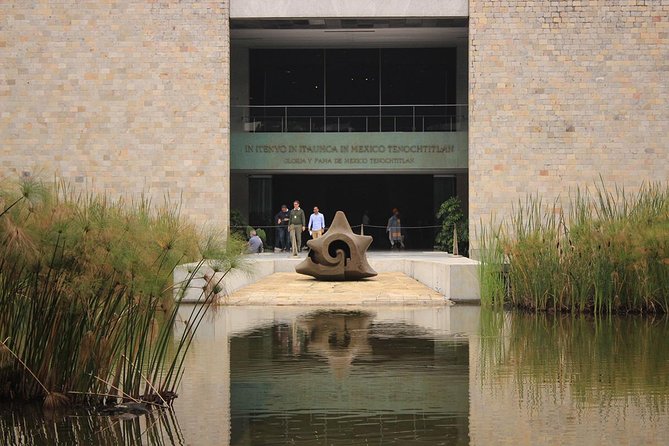
Reviewed · CHAPULTEPEC & THE ANTHROPOLOGY MUSEUM
Anthropology Museum Guided Tour
The National Museum gets way easier with a guide. This 2.5-hour English tour walks you through standout artifacts from the Maya world, the Aztecs, and the Olmecs, and it gives the background that most labels do not. You also get museum admission included, so the first step is just showing up and learning instead of sorting tickets.
I love the way the tour builds context, like turning the Aztec Calendar and the Stone of the Sun from famous objects into real cultural clues. And the small-group setup (up to 25 people) means guides can actually explain, like Alexa’s clear step-by-step flow and Leonardo’s use of reference photos and drawings that help you picture how places and buildings worked.
One thing to consider: English clarity and pacing can vary by guide, and you need to be on time. A couple of past groups complained about headphone or accent challenges, and the tour can feel chaotic if you arrive late.
In This Review
- Key points before you go
- National Museum of Anthropology in 2.5 hours (and why it works)
- Start at the right place: Polanco meets the museum’s scale
- Why guides matter here, especially with Spanish-heavy signage
- First stop, the museum’s “big picture” you actually need
- From Olmec giants to the Stone of the Sun: what you’ll actually notice
- Maya tomb reconstructions and the Sacred Cenote story
- The Aztec Calendar and how the guide keeps you from getting lost
- Group size, audio, and what to do if English is harder than expected
- Price check: does $39 deliver real value?
- Who should book this tour, and who might prefer a different plan
- Should you book this National Museum of Anthropology guided tour?
- FAQ
- Where is the meeting point for the tour?
- How long is the guided tour?
- Is museum admission included in the price?
- Is the tour offered in English?
- How many people are in each group?
- What items are you not allowed to bring?
- Is food included?
- Is it near public transportation?
- How far in advance is it usually booked?
- Can you cancel for a refund?
Key points before you go
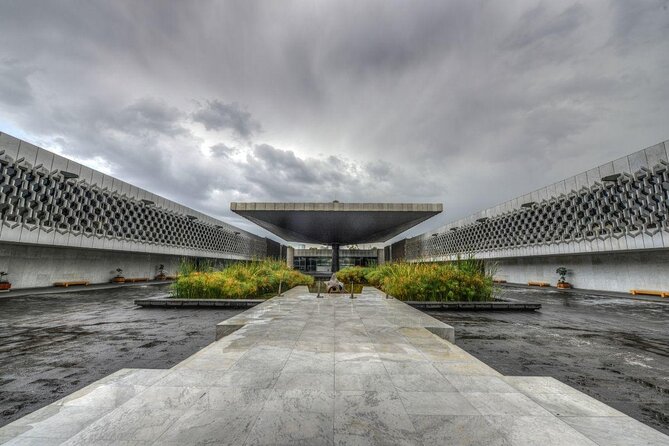
- Admission and a pro guide are included, so your money goes to interpretation, not just entry
- Maya to Spanish colonial context helps you connect different eras instead of seeing isolated artifacts
- Olmec giant heads and the Stone of the Sun are explained with the why, not only the what
- A Tenochtitlan model gives you geographic grounding fast, even if the museum feels huge
- Guides like Alexa, Alan, Ligia, and Antonio were repeatedly praised for clarity and engagement
- Most signs are Spanish, so the English narration does real work for you
National Museum of Anthropology in 2.5 hours (and why it works)
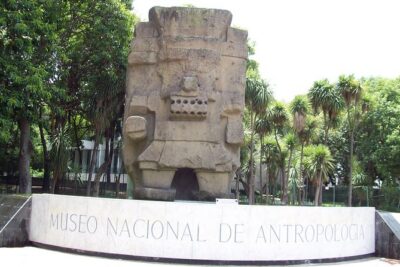
The National Museum of Anthropology, Museo Nacional de Antropología, is one of those places that can overwhelm you fast. Even if you love history, the museum is big, the exhibits move across centuries, and the labels can leave you guessing. This tour is built to solve that problem with a tight time window and an actual narrative.
I like that the tour targets exactly what most first-time museum visits miss: context. Instead of walking past objects like the Aztec Calendar or the Olmec heads as “cool rocks,” you get the archaeological and historical framing around them. That matters because many items only make full sense when you understand the society that made them, and what Spanish colonial rule changed afterward.
The timing is also a practical win. At about 2 hours 30 minutes, the morning option can leave your afternoon open for Chapultepec, neighborhoods around Polanco, or a second museum stop. If your Mexico City days are packed, this tour is one of the more efficient ways to get real learning without swallowing your whole day.
Other Chapultepec museum visits in Mexico City that earned a write-up
- Anthropology Museum Guided Tour
★ 4.5 · 1,035 reviews - Mexico City: Anthropology Museum Guided Visit
★ 4.4 · 708 reviews - Mexico City: Chapultepec Castle and Anthropology Museum Tour
★ 4.5 · 637 reviews - Mexico City: Anthropology Museum Skip-the-Line Ticket
★ 4.4 · 502 reviews - Anthropology Museum Private Experience Walking Tour
★ 5.0 · 355 reviews
Start at the right place: Polanco meets the museum’s scale
The meeting point is at Museo Nacional de Antropología, Av. P.º de la Reforma s/n, Polanco, Bosque de Chapultepec I Secc, Miguel Hidalgo, 11560 Ciudad de México. The tour also ends back at the same meeting point, which keeps navigation simple.
What I’d do with this info: treat the start time as strict. Some people reported confusion at the meet-up area and delays tied to ticket or headphone handling. If you show up late, you risk missing the group narrative at the exact moment it matters most, and you can’t really “catch up” inside a busy museum when everyone else has moved on.
Also note the rules: you can’t enter with food, drinks, or backpacks, only a handbag. It’s the kind of detail that can slow you down if you forget, so pack light and keep your hands free.
Why guides matter here, especially with Spanish-heavy signage
A big theme in the feedback is simple: the museum’s displays are stunning, but the written context can be hard to access quickly in English. One review specifically mentioned that only about 25% of signs were translated to English, and another noted that there are very few placards contextualizing what you’re seeing. That is exactly where this tour earns its keep.
I love tours where the guide turns museum randomness into a path. Many guides did that by structuring the visit from larger geography and timelines into specific artifacts. Alexa was described as starting with a high-level picture, then gradually going deeper, even using personal photos and drawings. Alan was praised for a clear progression and for patience when questions came up. Antonio received credit for making the museum feel like a story instead of a checklist.
What you should expect from a good version of this tour:
- The guide ties objects to broader events and building styles.
- You get a “what am I looking at?” answer before you start second-guessing yourself.
- You spend less time translating in your head and more time understanding.
What can go wrong, based on real complaints:
- Some English sessions were reported as hard to follow due to accent or audio/headphone problems.
- A few people felt the tour was more talk than interaction, with little time for questions.
- Some groups mentioned delays before headphones were handed out or before the tour could start.
My advice to protect your experience: if you care about English clarity, show up early, be ready to ask for a repeat, and keep expectations realistic for a museum day where timing can shift.
First stop, the museum’s “big picture” you actually need
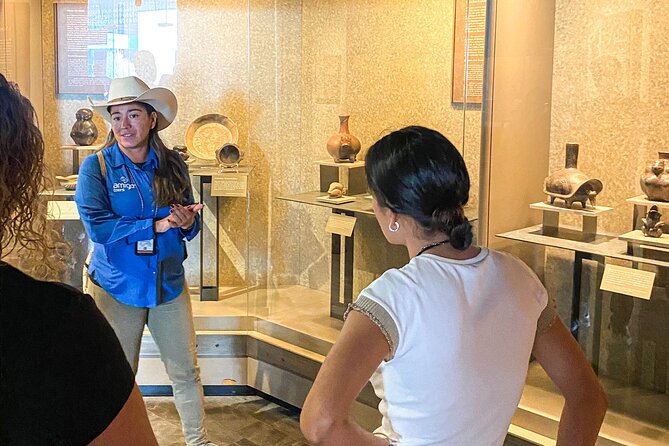
The tour’s one main stop is the Museo Nacional de Antropología, and it’s not just any route through rooms. The museum itself is described as a major ideological, scientific, and political achievement, and that’s the mindset the guide brings to the visit.
At the beginning, you’re likely to get the “why this museum is the way it is” framing: how it synthesizes Mesoamerican civilizations and how it situates them in relation to Spanish colonial history. That setup changes how you read everything afterward, because you start looking for connections instead of isolated facts.
The museum’s permanent exhibitions cover pre-Columbian civilizations across what is now Mexico, plus territory in today’s southwestern United States. That is a lot to process on your own. In a guided format, you get the thread that helps you place what you’re seeing into the right era and region.
If you’re the type who likes structure, you’ll probably feel grateful here. One positive review mentioned a guide giving key information, then letting people explore each salon more on their own. That pacing can be a sweet spot: you get direction without being marched nonstop.
From Olmec giants to the Stone of the Sun: what you’ll actually notice
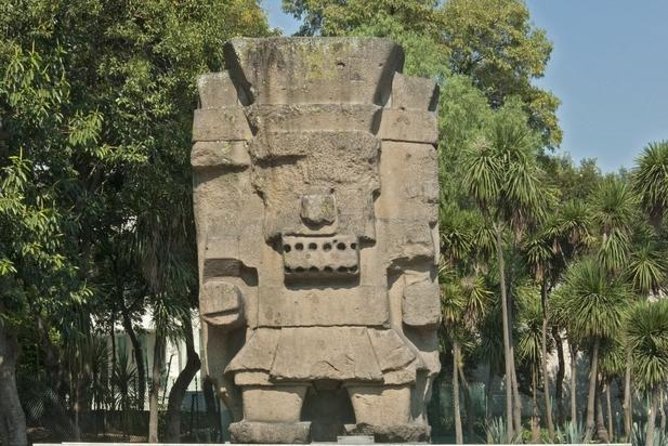
One of the biggest draws is that you’ll be looking at museum standouts with real explanation behind them. The tour highlights a cluster of major icons:
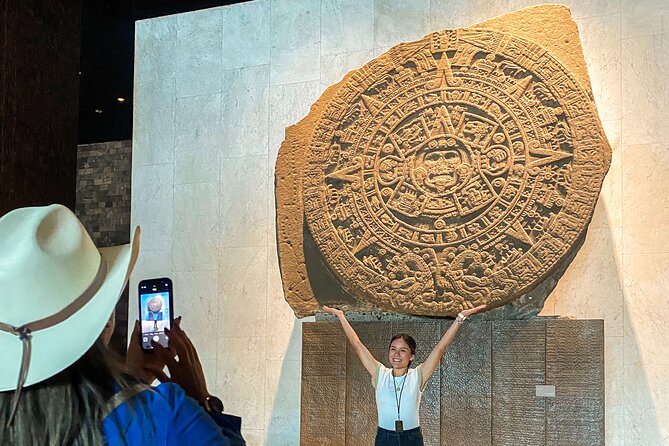
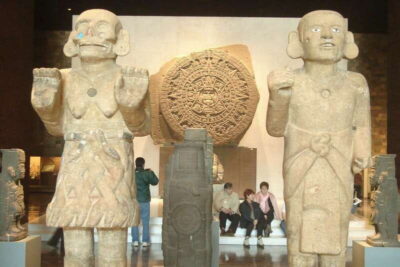
- The Stone of the Sun: Often famous as an artifact, but much more meaningful when you understand what it represents and how people used symbols in their worldview.
- Giant Olmec stone heads: These were found in the jungles of Tabasco and Veracruz, and the tour context helps you connect their location to the bigger question of how and where cultures formed and moved.
- Maya treasures, including items associated with major sites.
Even if you’ve seen photos online, the guide framing changes your experience. It’s the difference between “wow, that’s big” and “this size and design choice is telling us something.”
The museum also has a model of Tenochtitlan, the Aztec capital, on the same site where central Mexico City stands today. That model is one of those “use your brain” moments. It helps you map the past onto the city you’re walking around in now. More than once in the feedback, guides were praised for starting with geography and then returning to it as the tour moved through civilizations.
More guide-led bookings from our Mexico City shortlist
- Teotihuacan Early Access Guided Tour with optional Lunch★ 4.5 · 6,138 reviews
- Anthropology Museum Guided Tour★ 4.5 · 1,035 reviews
- Mexico City: Anthropology Museum Guided Visit★ 4.4 · 708 reviews
- Mexico City: Frida Kahlo Museum Entry Ticket w/Digital Guide★ 4.5 · 683 reviews
- Guided Tour in Teotihuacan with Cave Breakfast and Transportation★ 5.0 · 613 reviews
- Teotihuacan Private Tour with Expert Guide & Cultural Insights★ 5.0 · 577 reviews
- Teotihuacan Early Morning Tour: Avoid Crowds, & Expert Guide★ 5.0 · 568 reviews
Maya tomb reconstructions and the Sacred Cenote story
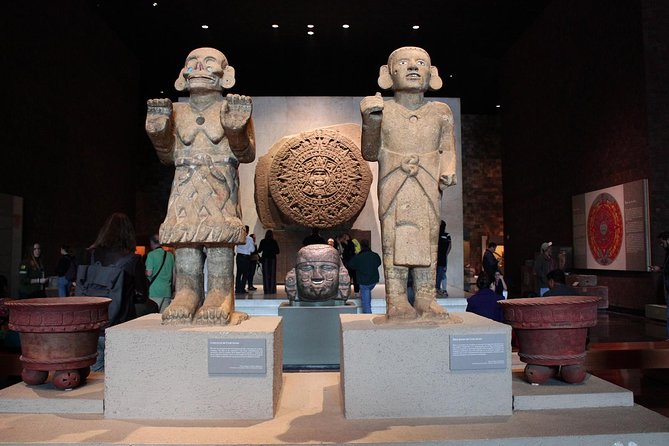
If the museum’s greatest strength is its span of cultures, the Maya pieces give you a strong emotional and intellectual anchor.
The tour description points to reconstructions of Maya tombs, which helps you stop treating the exhibits as static objects and start thinking about rituals, beliefs, and the purpose of burial spaces. That kind of reconstruction also makes it easier to understand why certain artifacts appear with specific contexts, rather than floating as unrelated highlights.
Another standout in the tour summary is the Sacred Cenote at Chichen Itza. The museum displays treasures recovered from that sacred water site, and the guide is there to connect the object to the practice that produced it. Without that connection, you can miss the point. With it, you see why the exhibit matters culturally, not just visually.
A practical benefit here: these sections are where your curiosity starts driving the pace. If your guide is interactive, you’ll likely have questions about symbolism, geography, and time periods. If your guide runs more lecture-style, these are still good stops because the key artifacts are strong enough that even a fast explanation lands.
The Aztec Calendar and how the guide keeps you from getting lost
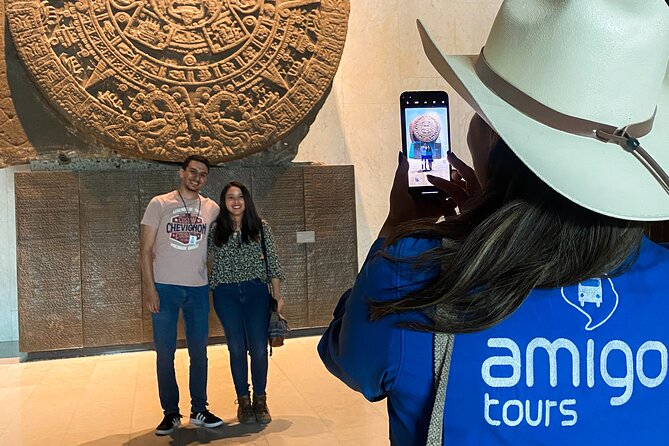
The Aztec Calendar can be a tricky exhibit for first-timers because it carries so much modern attention. A guided approach helps you avoid common confusion by placing it in its cultural system rather than treating it like a pop-myth object.
One of the praised approaches from multiple guides was starting with big picture geography and timeline, then making finer connections. That method is especially useful in a museum where rooms can blend into each other if you’re not tracking the sequence. When the guide keeps returning you to the “where are we in time and space?” question, the exhibits stop feeling like disconnected rooms.
You’ll also likely get help with the museum’s broader narrative across pre-Columbian civilizations and into Spanish conquest. Some guides were specifically praised for weaving this progression in a clear order, so you can feel a sense of arrival at the next era, not just a scramble through rooms.
Group size, audio, and what to do if English is harder than expected
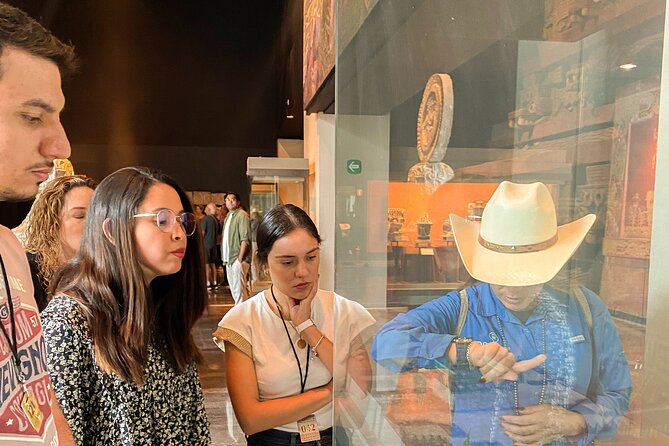
This tour is offered in English, and the size limit is up to 25 travelers. In practice, group size affects the feel of the tour. If you end up with a big pack, it can slow questions, and it can be harder to hear the guide clearly.
Audio is another variable. At least a few reviews mentioned headphones being part of the experience, and some complained about audio equipment or difficulty understanding the guide. That doesn’t mean the tour is always like that. It does mean you should arrive ready to work with the sound setup if it’s provided.
Here’s how you protect yourself:
- Stand close enough to hear without straining, especially at quieter exhibits.
- If you can’t follow, ask one specific clarification instead of general questions. Guides can usually fix a single gap fast.
- If you’re comparing guides, look for descriptions emphasizing patient explanations. That theme showed up repeatedly in the feedback tied to guides such as Genovanna, Ligia, Hector, and Leonardo.
Also remember, the museum itself can be busy. Even with a good guide, crowds at entrances and inside can affect timing. Plan to stay flexible.
Price check: does $39 deliver real value?
At $39 per person, the value depends on what you want. If you plan to wander alone, the price is hard to justify unless you already know what you’re looking for in Mesoamerican archaeology.
But this tour includes two key things that raise the value:
- Professional guide time
- Entrance to the National Museum of Anthropology
That means you’re not paying extra for entry, and your money goes into interpretation and navigation through a museum that otherwise may not explain itself fast enough in English. One review summed up the core benefit well: a guide can make a complex museum accessible instead of overwhelming, and without that guidance you may leave with the feeling that the exhibits are harder to connect than they should be.
The main “watch-outs” on value come from the negative feedback, where some people reported disorganization, delayed start moments, confusion about meeting points, or communication issues. Those are outliers, but they do matter. If you’re the kind of person who hates uncertainty, arrive early, keep your ticket and confirmation ready, and treat the start as something you actively manage.
Who should book this tour, and who might prefer a different plan
This tour is a strong fit if:
- You want a guided introduction to Maya, Aztec, and Olmec civilizations without doing a crash-course reading first.
- You appreciate a structured walk through a museum with limited fast English signage.
- You’re going in the morning and want to free up the afternoon.
You might think twice if:
- You are highly sensitive to English clarity or audio quality and cannot tolerate a less-than-perfect setup.
- You expect a fully interactive discussion style every minute. Some guides were praised for Q&A, but other feedback mentioned one-way lecturing.
- You dislike any start delays. Ticket validation and headphone handoff were both cited as potential sources of waiting.
The good news: even with these risks, the museum content is strong. A good guide amplifies it. A weak moment still leaves you surrounded by major artifacts like the Olmec heads and the Stone of the Sun.
Should you book this National Museum of Anthropology guided tour?
Yes, I think it’s worth booking if you want your first visit to feel coherent and you want someone to connect the dots between civilizations. The mix of iconic artifacts (Olmec heads, Stone of the Sun, Aztec Calendar) plus context for Maya items like the Sacred Cenote makes the guided format feel practical, not decorative.
Book it if you’re planning a morning slot and you want the afternoon free. And if you do book, do yourself a favor: be early at the Av. P.º de la Reforma meeting point, pack only a handbag since backpacks are not allowed, and keep expectations realistic for a busy museum.
If you’ve ever left a big museum frustrated because you couldn’t tell what mattered most, this tour is designed to prevent that. You’ll likely walk out knowing the story behind what you saw, not just the names on the walls.
FAQ
Where is the meeting point for the tour?
The tour starts at Museo Nacional de Antropología, Av. P.º de la Reforma s/n, Polanco, Bosque de Chapultepec I Secc, Miguel Hidalgo, 11560 Ciudad de México.
How long is the guided tour?
It lasts about 2 hours 30 minutes.
Is museum admission included in the price?
Yes. Entrance to the National Museum of Anthropology is included, along with the guided tour.
Is the tour offered in English?
Yes, the tour is offered in English.
How many people are in each group?
This activity has a maximum of 25 travelers.
What items are you not allowed to bring?
You are not allowed to enter with food, drinks, or backpacks. A handbag is allowed.
Is food included?
No. Food and drinks are not included.
Is it near public transportation?
Yes, the meeting area is near public transportation.
How far in advance is it usually booked?
On average, it is booked about 15 days in advance.
Can you cancel for a refund?
Yes. It has free cancellation, and you can cancel up to 24 hours in advance for a full refund.
The rest of our guide-led bookings in Mexico City
Keep comparing guided outings across Mexico City

Chapultepec museum visits still worth a look around Mexico City
Not quite it? More Mexico City tours from our review pile





Chapultepec & the Anthropology Museum in one list.
 ★ 4.5Chapultepec Castle & Anthropology Museum TourFrom $791,348 reviews
 ★ 4.4Mexico City: Anthropology Museum Guided VisitFrom $67708 reviews
 ★ 4.5Mexico City: Chapultepec Castle and Anthropology Museum TourFrom $47637 reviews
 ★ 4.4Mexico City: Anthropology Museum Skip-the-Line TicketFrom $15502 reviews
 ★ 5.0Anthropology Museum Private Experience Walking TourFrom $78355 reviews
 ★ 5.05 Hour Tour through Chapultepec, Anthropology Museum and CastleFrom $61239 reviews
 ★ 5.0PRIVATE Tour in Chapultepec Castle and Museum of AnthropologyFrom $113144 reviews
 ★ 5.0PRIVATE Tour Chapultepec CastleFrom $66130 reviews
Where else it sits