
Reviewed · HISTORICAL TOURS
Gay Side of History through Plazas & Temples
Mexico City has a way of hiding its real stories in plain sight. This Gay Side of History walk threads LGBTQ+ context through the biggest landmarks of the Historic Center, from rooftop views over Aztec ruins to the city’s most famous plazas. What I like most is the digital LGBT+ map plus extra resources to keep you oriented as you explore, and the small-group feel that makes the guide’s storytelling more personal.
One thing to consider: this is a compact, history-heavy walking tour. You’ll cover about 1 mile in around 3.5 hours, so it helps if your legs are okay with steady pace and outdoor time in all weather.
In This Review
- Key highlights worth clocking
- Rooftop start at Librería Porrúa: ruins, Frida views, and a big-city intro
- From Templo Mayor to the Metropolitan Cathedral: seeing power change hands
- Zócalo and the National Palace: where history meets everyday life
- Centro Cultural de España and the Old Customs Building: old walls, changed purposes
- Santo Domingo Plaza and the Portal de Evangelistas: working history in real time
- Price and time: is $99 a good deal for this 3.5-hour walk?
- What the 10am, all-weather format really means for your day
- Who this tour is for, and who should choose something else
- Should you book the Gay Side of History through Plazas & Temples?
- FAQ
- How long is the Gay Side of History through Plazas & Temples tour?
- How much does the tour cost?
- Is the tour in English?
- How many people are in the group?
- What’s included with the tour?
- Where does the tour start and where does it end?
- How much walking will I do?
- What is the cancellation policy?
Key highlights worth clocking
- Digital LGBT+ map of the Historic Center, plus added resources to use before or after the tour
- Small group, max 10 travelers, which usually means more Q and A time
- Rooftop balcony start at Librería Porrúa, with views toward the Templo Mayor ruins and sights tied to Frida Kahlo
- Free stops at the Zócalo and Cultural Center of Spain area, so you’re not stuck paying entry fees repeatedly
- Portal de Evangelistas at Plaza de Santo Domingo, where you can spot working typewriters and antique printing machines
- PDF download of RAINBOW MEXICO, designed to extend the stories you hear on the street
Rooftop start at Librería Porrúa: ruins, Frida views, and a big-city intro
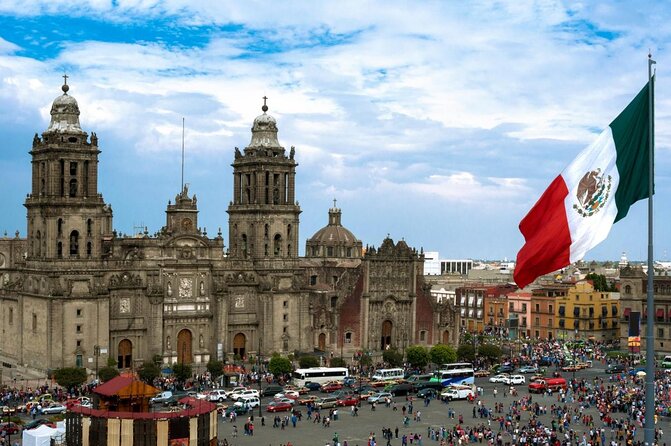
The tour kicks off near the Historic Center with a practical goal: help you see Mexico City as a layered place, not a pile of separate monuments. Your first stop is Librería Porrúa, where a rooftop balcony gives you a clean, elevated perspective over several key sights at once. You can look toward the Palace of the Royal Duty, the Hideaway Rooms of Frida Kahlo, and the Great Aztec Temple ruins. It’s a strong way to start because your brain instantly connects the dots, instead of treating the day like a checklist.
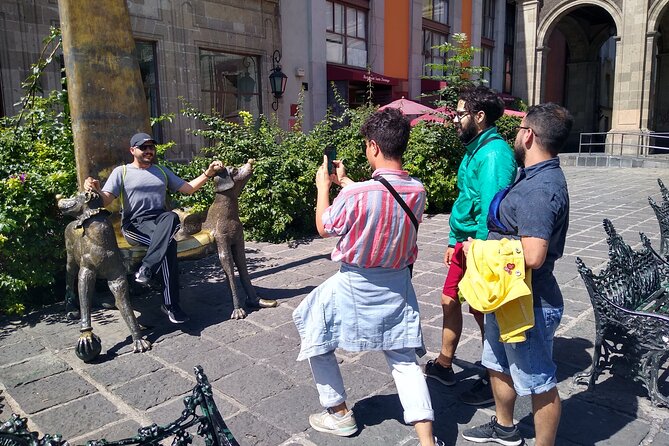
This is also where the tour’s tone shows. The best moments come from the guide’s storytelling, and Carlos is repeatedly praised for doing it in a way that stays lively even when the topic turns serious. You get coffee and/or tea plus bottled water as you settle in, which is not a small detail in a city where midday sun can be brutal.
A practical note: you’ll want a phone with decent battery. You’ll be using the map during the walk, and that first rooftop view makes more sense if you can quickly pull up what you’re looking at.
Still deciding? These history walks in Mexico City are reviewed too
- Historic Downtown Walking Tour
★ 5.0 · 1,289 reviews - Historic Center Food Tour in Mexico City
★ 5.0 · 1,263 reviews - Mexico City: Historic Downtown Walking Tour
★ 4.8 · 1,039 reviews - Walking Tour of the Historic Center of Mexico City
★ 5.0 · 870 reviews - Mexico City Historical Centre Food Tour with 7 Authentic Tastings
★ 5.0 · 723 reviews
From Templo Mayor to the Metropolitan Cathedral: seeing power change hands
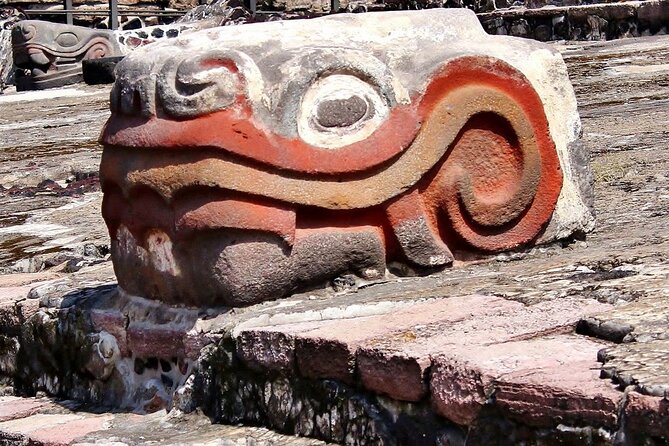
After you get your bearings above the area, you move into the heart of the historic zone where different eras overlap. The Templo Mayor, the main temple of the Mexica (Aztec) people, anchors the day early on. Even if you’ve heard of it before, the tour framing helps you understand it as a living part of the city’s identity, not just an archaeological site.
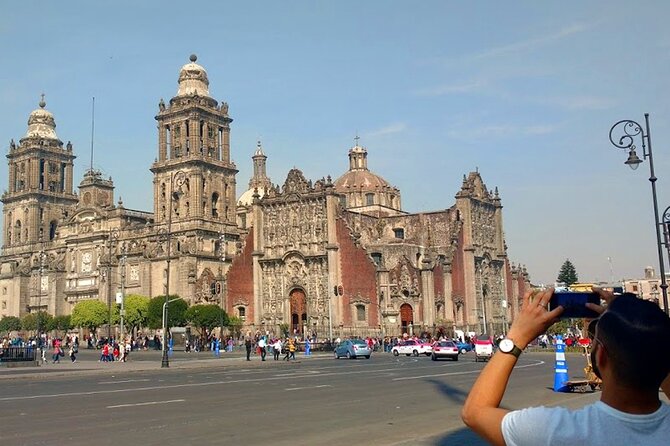
Then the route shifts to the Metropolitan Cathedral of the Assumption of the Most Blessed Virgin Mary into Heaven. This stop matters because it shows the post-conquest replacement of old sacred space with new Catholic power. When you’re listening for the LGBTQ+ layer, you’re not trying to force a connection. You’re learning how conquest, religion, and law formed a new reality, and how that reality affected who had room to exist openly.
The travel value here is simple: you see two major spiritual centers in one arc. You also learn how quickly a city can rewrite its meaning while keeping the same street plan. That helps a lot when you later wander on your own, because you start noticing why a plaza is where it is and why a building faces the way it does.
Zócalo and the National Palace: where history meets everyday life
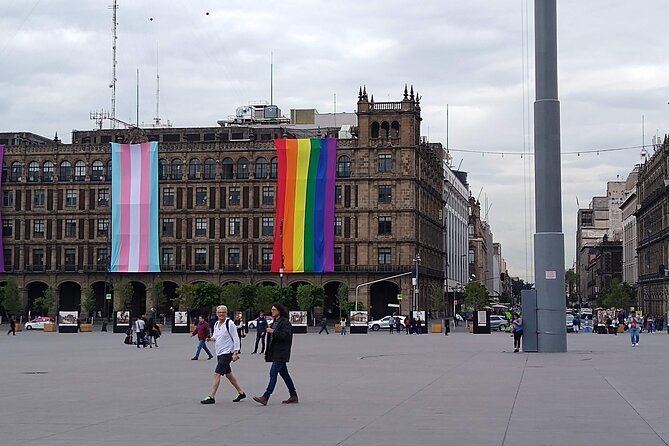
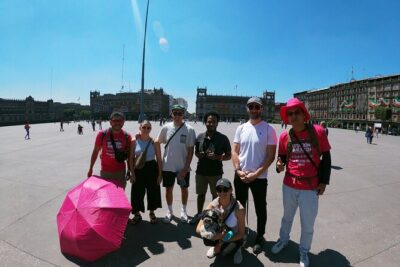
Next up is the Zócalo, the central plaza and meeting point of Mexico City. This is one of those places where everyone ends up eventually, but the tour gives you a reason to look closely instead of just standing in the center for photos. You’re there long enough to notice the plaza as a stage: it’s where politics happens, where people gather, and where national identity gets performed daily.
Then you connect the plaza to the National Palace (Palacio Nacional), seat of the federal executive. Since 2018, it has also served as the official residence for the President of Mexico. The point isn’t memorizing dates. It’s understanding how power is displayed in stone and ceremony, and how that connects to the wider social history you’re tracking through the day.
This segment is also a good spot to pause mentally. If you’re the type who normally rushes through landmarks, the Zócalo time helps you slow down and actually read the city. You can stand, breathe, and decide how you want to spend the rest of your Mexico City hours.
Centro Cultural de España and the Old Customs Building: old walls, changed purposes
Moving from the biggest plaza energy, the tour heads toward the Centro Cultural de España en México. The address is 18 Guatemala Street, behind the Cathedral area. The story here is about how old spaces get repurposed: the mansion was ceded to Spain when it fell into ruins, then restoration brought it back and it reopened in 2002 with major political attention.
In practical terms, this stop gives you a reset. After the Zócalo and the political gravity of the National Palace, you get a different kind of historical lesson: buildings can be damaged, saved, and rebranded. That matters when you’re trying to understand how LGBTQ+ lives and queer memory survived, changed, or went underground.
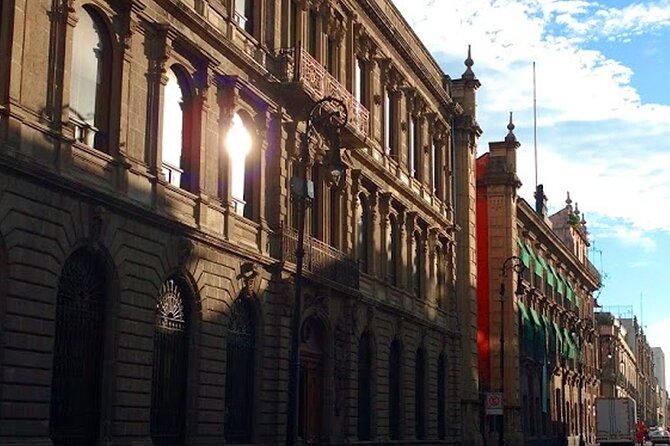
You also pass the Old Customs Building, on the east side of Santo Domingo Plaza between Republica de Venezuela and Luis Gonzalez Obregon Streets. Customs buildings are a quiet kind of power. They signal trade routes, control of goods, and movement through the city. When the guide ties this setting back to LGBTQ+ context, it helps you see how the ability to travel, gather, or hide could affect real lives.
Santo Domingo Plaza and the Portal de Evangelistas: working history in real time
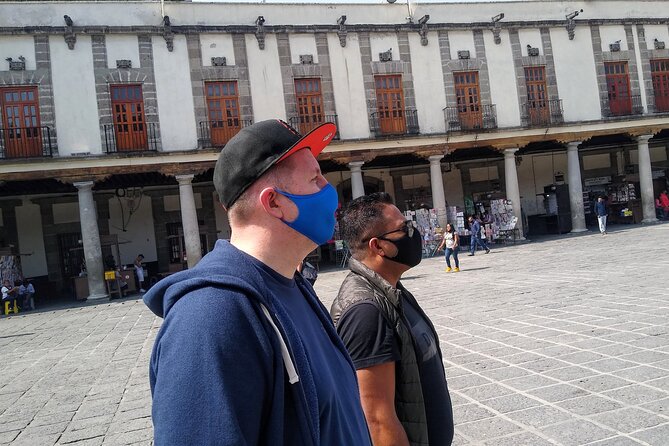
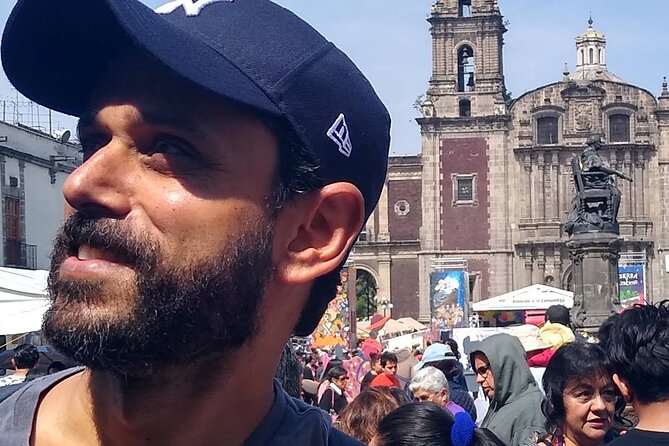
Plaza de Santo Domingo is where the tour turns especially visual. The square is flanked to the west by the Portal de Evangelistas, a Tuscan colonnade with round arches. Under those arches, you may see scribes working with typewriters and antique printing machines. It’s the kind of scene that feels almost cinematic, except it’s happening right now, which makes it more memorable than a static landmark.
This part of the day also carries a difficult historical thread. The tour frames the Spanish Inquisition as a civilian institution that executed convicted homosexuals between 1521 and 1821. Standing near key historic religious and civic spaces, you can feel how law and fear shaped public life. It’s heavy material, but the way it’s placed in context can help you understand why LGBTQ+ history in many places is scattered, coded, or forced into silence.
On the north side of the plaza is the Church of Santo Domingo, facing the square. And nearby, you’ll hear about El Camino Real, described as starting from Old Mexico to New Mexico, a trading route and a safe haven for gay male couples. That kind of detail is exactly why this tour is valuable: it makes you look at “normal” routes and ask who used them, who depended on them, and who was protected by them.
- Teotihuacan, Guadalupe Shrine & Tlatelolco Day Tour with Lunch★ 5.0 · 11,603 reviews
- Xochimilco, Coyoacan and Frida Kahlo with Optional Lunch★ 4.5 · 7,320 reviews
- Balloon flight + Breakfast in cave + Pyramids + Pick up CDMX.★ 5.0 · 6,335 reviews
- Teotihuacan pyramids morning or afternoon without tourist traps★ 5.0 · 6,186 reviews
- Teotihuacan Early Access Guided Tour with optional Lunch★ 4.5 · 6,138 reviews
- Balloon flight + pick up in CDMX + Breakfast in Cave + Pyramids★ 5.0 · 5,651 reviews
- Balloon Flight + Cave Breakfast + Pick Up from CDMX or We Fly★ 5.0 · 4,410 reviews
Price and time: is $99 a good deal for this 3.5-hour walk?
At $99 per person for about 3 hours 30 minutes, the value comes down to format and guidance quality, not just access to landmarks. You get a local guide, coffee and/or tea, bottled water, and a digital LGBT+ map with extra resources. You also get downloadable PDF content, RAINBOW MEXICO, which gives you something to read and connect later.
The time commitment is modest in distance terms, about 1 mile total. It still feels like a full lesson because the tour is packed with interpretive stops, including one stop with an admission ticket at Librería Porrúa. Several other featured sites are free to visit, which keeps the cost from feeling like you’re paying entry fees over and over.
The big “value lever” is the small-group setup, max 10 travelers. That usually means you can ask questions and get answers that fit what you want to learn, which is one of the themes that shows up in the best experiences people report.
If you’re trying to squeeze in history while keeping your day flexible, this is a smart first anchor. It also works well as a confidence builder on your first Mexico City day, because it helps you understand the geography fast.
What the 10am, all-weather format really means for your day
The tour starts at 10:00 am. It runs in all weather conditions, so you should dress for sun and sudden rain. The tour also asks for moderate physical fitness and includes walking for about 1 mile in 3 hours. That’s not a long hike, but it is a steady walk with stops, so plan for outdoor time.
The route is also well placed for public transportation access, which matters because Mexico City can be time-variable. If you’re staying in the Centro Histórico area, it’s easy to slot in. If not, I’d build extra time for transit so you’re not stressed at the start.
Your meeting point is República de Argentina 15, Centro Histórico de la Cdad. de México, Centro, Cuauhtémoc, 06020 Ciudad de México, CDMX, Mexico. Your end point is at Plaza de Santo Domingo, at the corner of República de Venezuela and República de Brasil streets, near Antiguo Palacio de la Santa Inquisición in the same historic area.
Who this tour is for, and who should choose something else
This is ideal if you want history that is more than monuments. You’ll like it if you enjoy guided context, want LGBTQ+ perspectives placed directly into the city’s most famous spaces, and appreciate a route that mixes rooftops, cathedrals, plazas, and street-level details.
It’s also a good choice for allies who want a serious, respectful introduction without feeling like it’s performative. The guide style is described as engaging and funny at times, while still taking serious history seriously, so the day doesn’t flatten into lectures.
If you prefer unguided wandering or you want museums with long indoor exhibits, this might feel too “outside and on-the-move.” It’s walking through the city’s public face, so it rewards attention and curiosity, not just photo stops.
Should you book the Gay Side of History through Plazas & Temples?
If you want one high-impact, LGBTQ+ focused overview of Mexico City’s Historic Center, I think this is an easy yes. The combination of a small group, a practical digital LGBT+ map, and a guide who can explain big themes without making you feel lost is exactly the kind of value that makes a tour worth your time.
Book it if you like guided context, you’re okay with steady walking, and you want to leave with a clearer mental map of how Mexico City’s major institutions shaped daily life across centuries. Skip it only if you want a long museum-style experience or you’re struggling with any kind of walking comfort, since the tour is designed around a compact route and outdoor stops.
FAQ
How long is the Gay Side of History through Plazas & Temples tour?
It runs for about 3 hours 30 minutes.
How much does the tour cost?
The price is $99.00 per person.
Is the tour in English?
Yes, it is offered in English.
How many people are in the group?
The tour has a maximum of 10 travelers.
What’s included with the tour?
You get a local guide, coffee and/or tea, bottled water, a digital LGBT+ map of the Historic Center with extra resources, and a downloadable PDF copy of the e-book RAINBOW MEXICO.
Where does the tour start and where does it end?
It starts at República de Argentina 15, Centro Histórico de la Cdad. de México. It ends at Plaza de Santo Domingo, near the corner of República de Venezuela and República de Brasil streets.
How much walking will I do?
You will walk for about 1 mile in 3 hours.
What is the cancellation policy?
You can cancel up to 24 hours in advance for a full refund. If you cancel less than 24 hours before the start time, the amount paid is not refunded.
Other history walks we have been through in Mexico City
Not quite it? More Mexico City tours from our review pile


Historical Tours in one list.
 ★ 5.0Historic Downtown Walking TourFrom $261,289 reviews
 ★ 5.0Historic Center Food Tour in Mexico CityFrom $1151,263 reviews
 ★ 4.8Mexico City: Historic Downtown Walking TourFrom $261,039 reviews
 ★ 5.0Walking Tour of the Historic Center of Mexico City870 reviews
 ★ 5.0Mexico City Historical Centre Food Tour with 7 Authentic TastingsFrom $65723 reviews
 ★ 5.0Historical and Cultural Walking Tour of San Miguel de AllendeFrom $34641 reviews
 ★ 5.0Historical and Cultural Walking Tour of San José del Cabo576 reviews
 ★ 5.0Walking Tour in Mexico City for Exploring their Cultural HeritageFrom $25245 reviews
Where else it sits